

Your Professional Data Cable Supplier
Our goal is to become your true partner in the field of butterfly-shaped indoor optical cable in China. Potel Cable Group Co, Ltd has a complete smart communication industry chain, with two major industrial production and R&D bases. We have a skilled engineering team dedicated to refining every stage, from product development and process improvement to production oversight, ensuring every product delivered meets rigorous quality and performance standards. The price is competitive and the product is quality-assured, which is a good choice for your long-term cooperation.




Why Choose Us
Production equipment: Our company has 500 sets of production line manufacturing equipment, and has built 3 fiber drawing towers and 6 fiber production lines.
Production market: Our company's products are very popular in the market, providing first-class products and high-quality technical services to telecom operators, smart building industry and communication industry customers in more than 20 countries and regions around the world.
Our certificates: We have established a strict quality control system and won 145 communication product certifications. Our production and manufacturing have won IS09001, IS014000, 0HSAS8000, US UL certification, EU CE certification, environmental protection RoHS and other quality certifications.
Our services: In the pre-sales stage, our team of experts will recommend the most suitable products according to the needs of customers and provide detailed technical consultation. During the sales period, we ensure timely delivery and provide installation guidance. For after-sales, we provide long-term technical support, warranty services and spare parts to help customers maximize the use of products and get reliable maintenance during use.
Advantages of Data Cable
Security:
One of the primary advantages of network data cabling is that they provide a higher level security than wireless networks. Although measures of security including passwords and protected wi-fi networks help to improve the security for wireless networks, they are never as secure as network cabling systems.
Reduced interference:
Proper installation of network data cabling helps to dramatically reduce the interference caused by electrical and radio frequency, known as electromechanical interference and radio frequency interference, respectively.


Consistent connection:
One of the biggest concerns that many wireless network users have is the inconsistency of the connection. As data transfer is performed, a lapse in the network connection caused by a momentary lapse in the wireless signal or electrical interference can effectively negate a great deal of work, slow down the transfer rate considerably, or introduce unacceptable levels of data corruption.
Mobility:
Wireless networks provide excellent mobility for electronic devices because there are no wires to hinder movement, within the range of the transceiver.
Specification of Data Cable
|
Conductor |
Conductor material |
Copper |
|
Excellent shielding structure design to ensure stable and outstanding shielding performance |
1/0.50±0.01 |
|
|
DC resistance of single conductor 100 meters (ohm) |
≤9.5 |
|
|
Insulation |
Insulation material |
HDPE |
|
Pair of wires |
Blue-White/Blue (mixed color), Orange-White/Orange (mixed color), Green-White/Green (mixed color), Brown-White/Brown (mixed color) |
|
|
Tear rope |
Specifications |
Twisted rope |
|
Sheath |
Material |
B1 level LSZH |
|
Nominal outer diameter of the cable sheath (in millimeters) |
4.9±0.2mm |
|
|
Insulation elongation at break (%) |
Implemented in accordance with the relevant standards of YD/T1019-2013 |
|
|
Minimum bending radius of sheath (millimeters) |
8 times the nominal outer diameter of the cable |
Types of Data Cable
Coaxial cable: Coaxial cables are generally used for television or telephone communication data transmission to residences. While they can be used for a commercial network, it is much more common to find them used for residential projects. There are many different types of coaxial cable, but they generally consist of a central core conductor (copper wire), a dielectric insulation material, a metallic shield, and a plastic outer sheath jacket to protect it.
Fiber optic cable: Fiber optic cable is used for fast internet connections. They are long, thin, strands of carefully drawn glass (about the diameter of a human hair) that are bundled together to create an optical cable. These cables transmit light particles that are encoded with data. Fiber cables are used to transmit communication and video signals.
Twisted pair: Twisted pair cables are most often used in telecommunications and computer networks. Meaning you will mostly find them in commercial businesses with a larger network infrastructure. They consist of two separate insulated wires that are twisted together and run parallel to each other.
Features of Data Cable
1
B1 flame-retardant lszh sheath (t0/d0 toxicity rating).
2
Zero halogen emission for reduced environmental impact.
3
Configurable to gb31247 b1/t2/d2 standards.
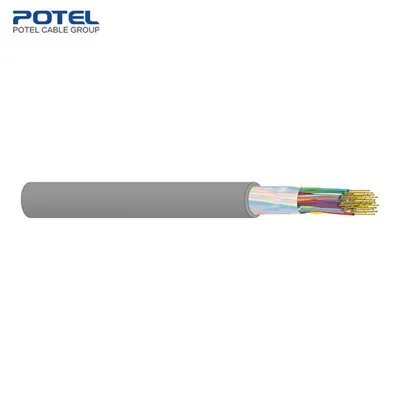
Data cables are used for the transmission of measuring, control and voice signals in electronic control appliances, in electronics of data processing systems, for paging and intercom systems, weighing installations, office machines, etc. The cables can be used for fixed installations and flexible applications with free movement, without tensile load and mechanically guided movement in dry, damp and wet rooms. They are not suitable for outdoor use.

Packing and Shipping of Data Cable
|
Packing |
Corrugated boxes |
|
Shipping |
Shipped by road, sea, rail |
FAQ
As one of the leading data cable manufacturers in China, we warmly welcome you to wholesale discount data cable from our factory. All customized products are with high quality and low price. Contact us for free sample.